Your dog doesn't cry like you do. Your cat doesn't scream when something hurts.
And yet… their body may be undergoing one of the most intense biological responses in existence.
Pain doesn't start where you think it does. It doesn't start at the wound. It begins in a system designed to detect danger even before the damage is evident. Understanding how pain works isn't just science: it's the difference between detecting suffering… or ignoring it completely.
🔍 WHAT WILL YOU LEARN IN THIS ARTICLE?
- What pain truly is from a veterinary physiology perspective.
- How nociceptors detect a threat.
- Why there are two types of pain (fast and slow).
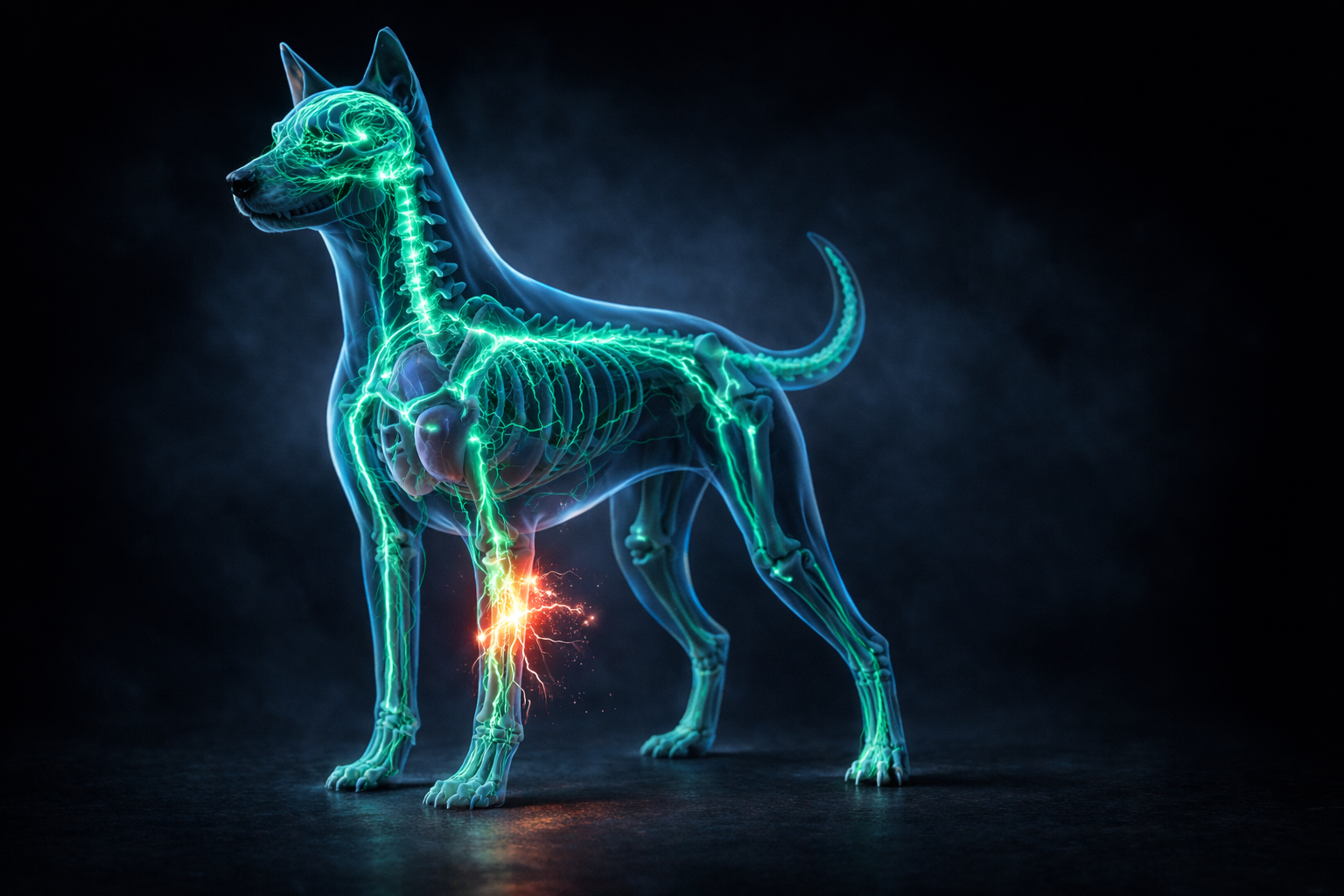
- What happens inside the body from the moment of injury to the brain.
- The 4 critical phases of pain (nociception).
- Which chemical substances amplify pain without you noticing.
- How the nervous system decides how much something "hurts."
🧠 WHAT IS PAIN, REALLY?
Pain is more than just a sensation. It is a biological alarm system. Based on physiological foundations, it is defined as an unpleasant sensory and emotional experience that arises in response to actual or potential injury.
But here is the key takeaway:
- Pain does not only appear when there is damage: It can be activated even before… as a survival mechanism.
- Its purpose is not to cause suffering: Its function is to prevent the destruction of the organism.
Believing that if the animal doesn't complain… there is no pain. False. Pain triggers stress, fear, and physiological changes described in the pain–stress–fear interaction. Many animals mask these signs as an evolutionary strategy to avoid appearing vulnerable to predators.
🔬 THE START OF EVERYTHING: NOCICEPTORS
Before pain exists… there is detection. Nociceptors are free nerve endings that act as biological sensors. They are found primarily in the skin (≈90%), but also in internal tissues.
Their function is to detect any potentially harmful stimulus, responding to:
- Mechanical pressure.
- Extreme temperatures.
- Chemical substances released by cellular damage.
In other words: they are the body's surveillance system.
⚡ TWO SPEEDS OF PAIN
Not all pain is equal, and not all pain travels along the same "highway":
🧵 A-δ Fibers (Fast Pain)
These are myelinated fibers with high conduction velocity (5–30 m/s). They transmit acute, sharp, and localized pain. Example: an immediate prick or cut.
🧵 C Fibers (Slow Pain)
These are unmyelinated and slow (0.5–2 m/s). They transmit diffuse, burning, and persistent pain. Example: the inflammation that remains after a blow.
💡 This explains why you first feel a sharp pain followed by a dull ache that won't go away.
🧬 WHEN THE BODY STARTS “MANUFACTURING” PAIN
Pain is not only detected… it is also amplified. When tissue injury occurs, the organism releases substances such as:
- Prostaglandins (PGE2)
- Bradykinin and Histamine
- Serotonin and Ions (H+, K+)
These substances do something critical: they sensitize nociceptors. The result is a heightened response to the stimulus and increased pain intensity, even without a strong stimulus. This is where "exaggerated" pain begins.
🔄 THE 4 PHASES OF PAIN (THE REAL PROCESS)
Pain is not an event; it is a chain process that occurs in 4 stages:
- TRANSDUCTION: The harmful stimulus is converted into an electrical signal.
- TRANSMISSION: The signal travels toward the spinal cord and the brain.
- MODULATION: The nervous system can amplify or dampen the signal.
- PERCEPTION: The brain interprets the signal. Pain does not exist until the brain processes it as such.
🧠 THE PATH OF PAIN THROUGH THE BODY
The path is precise: Injury → Nociceptor → Spinal Cord → Thalamus → Cerebral Cortex. This circuit connects physical sensation, neurological processing, and emotional experience. That is why pain is never just physical.
🧩 WHY DO SOME AREAS HURT MORE?
Not all tissues are created equal. The most sensitive areas include:
- Cornea: Up to 600x more sensitive than the skin.
- Dental pulp and Meninges.
- Serous membranes.
In contrast, muscle is less sensitive, and bone usually hurts primarily in response to pathologies of the periosteum.
🧠 CONCLUSION
Pain is not a simple symptom. It is a complex network of detection, transmission, and emotion. Understanding it not only improves diagnosis; it changes how you interpret animal suffering. Remember: pain is often invisible… but it is definitely happening.