Your pet could be suffering… without making a single sound.
Not all pain is created equal.
Some appear suddenly. Others hide for weeks. And there are those you can't even pinpoint… yet they are happening deep inside the body.
The problem isn't just the pain itself. The problem is not knowing how to identify which type of pain your animal is experiencing.
🔍 WHAT WILL YOU LEARN IN THIS ARTICLE?
- Differences between acute and chronic pain.
- What somatic and visceral pain are.
- How to recognize neuropathic pain.
- Why some types of pain are invisible.
- Which type of pain is the most dangerous.
- How to interpret real signals in your pet.
Thinking all pain is the same. It isn't. Each type of pain originates differently, manifests differently, and evolves differently. And the most dangerous part: some show no obvious signs.
🧠 Classification of pain in animals
According to veterinary physiology, pain is classified into three fundamental groups:
⏳ 1. Pain by duration: Acute vs. Chronic
🔴 Acute pain: Immediate pain. Sudden onset, short duration (days or weeks), and a clear cause.
Examples: Wounds, surgeries, trauma, or fractures.
👉 Function: To alert and protect the organism.
⚫ Chronic pain: Pain that persists. It lasts more than 3 months, may have no evident cause, and remains active over time.
Examples: Joint problems, degenerative diseases.
👉 Critical fact: Here, pain stops being a signal… and becomes a disease in itself.
⚙️ 2. Pain by origin: Nociceptive vs. Neuropathic
🔥 Nociceptive pain: The "classic" pain. It stems from tissue damage and directly activates nociceptors. It affects skin, muscles, and internal organs. This is the most common type in veterinary clinics.
⚡ Neuropathic pain: Here, the problem isn't in the tissue, but in the nervous system. Pain is generated without a clear stimulus, is persistent, and very difficult to treat. It is pain that the system "creates" on its own.
📍 3. Pain by location: Somatic vs. Visceral
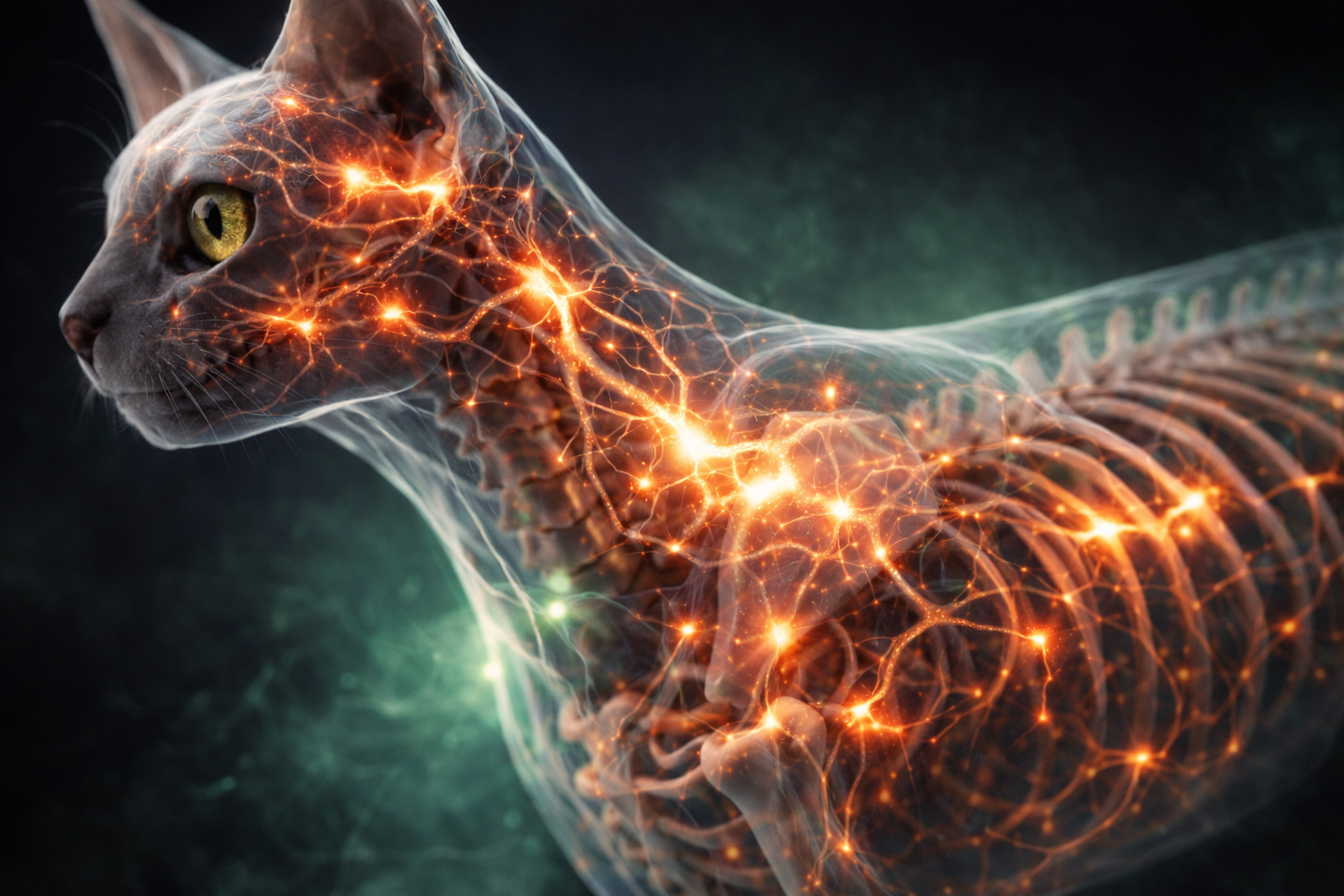
🧍 Somatic pain: Can be superficial or deep. It is well-localized and easy to identify.
Examples: Cuts, fractures, or muscular inflammation.
🫀 Visceral pain: Originates from internal organs. It is diffuse and extremely difficult to pinpoint.
Examples: Colic, digestive issues, or internal inflammation.
👉 Danger: It can be intense without showing obvious external signs.
🧠 Why is some pain invisible?
Not all tissues react the same way. According to physiological evidence:
- Cornea: Extremely sensitive.
- Dental pulp: Highly painful.
- Meninges: High sensitivity.
While muscle is less sensitive and bone usually presents indirect pain. This explains why some pains are visible at a glance while others are completely silent.
The most dangerous pain isn't the most intense, but the one that goes undetected: chronic pain and visceral pain. The animal adapts, there is no visible wound, and the system stays internally activated, draining their biological resources.
🔄 Can the type of pain change?
Yes. Pain can evolve: it starts as acute, becomes chronic, and can transform into neuropathic pain. This happens when the nervous system changes how it processes the signal.
🧠 Understanding this changes everything
Identifying the type of pain is only the first step. To understand the full process of how it's generated, transmitted, and interpreted by the brain:
❓ FAQ – Frequently Asked Questions
Look for behavioral changes: decreased activity, lack of appetite, isolation, or abnormal postures. These are more reliable signs than vocalization.
Yes. Mammals and birds possess complex nervous systems capable of processing pain in a very similar way to ours.
Absolutely. Especially in neuropathic pain, where the nervous system generates the signal without current external damage.